
Creatine after menopause: what a 2026 meta-analysis of seven trials actually shows
Seven randomised trials, 608 women, a median of 38 weeks. Pooled: +0.37 kg of lean mass and +7.5 kg on leg-press 1RM — but only at 5 g/day or more, combined with resistance training. What the numbers mean for anyone formulating with creatine monohydrate.
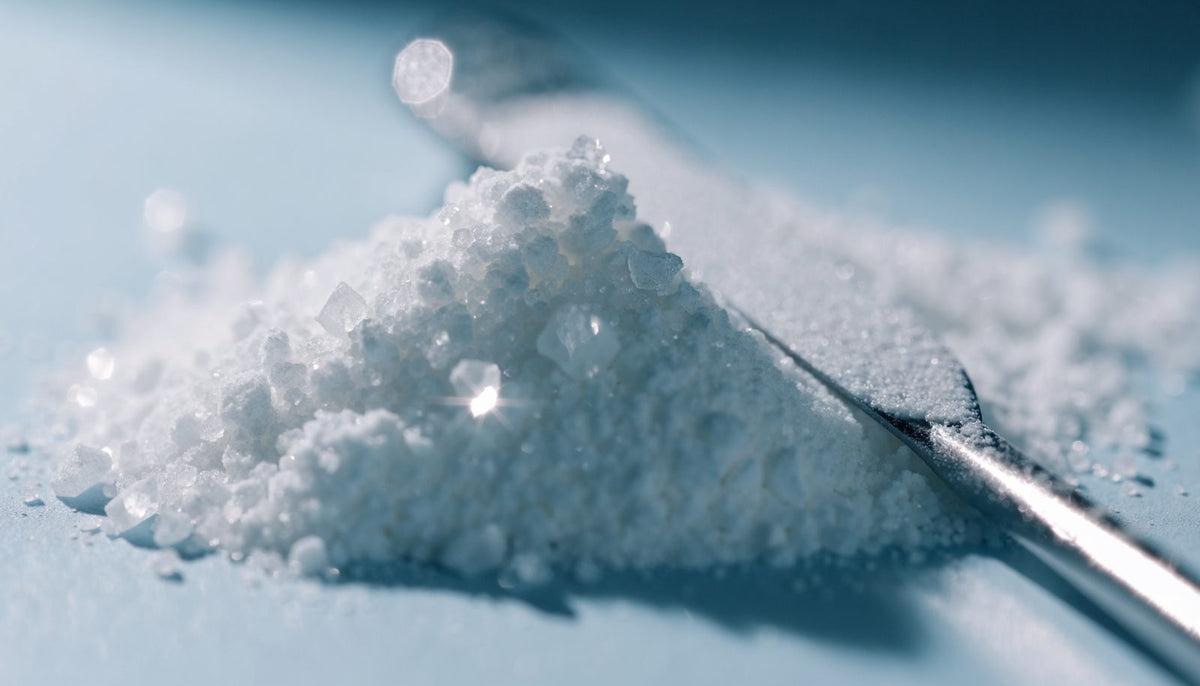
- Seven randomised placebo-controlled trials (608 women, median 38 weeks) were pooled. Creatine monohydrate produced +0.37 kg of lean mass and +7.5 kg on leg-press 1RM versus placebo.
- The effect only appeared at ≥ 5 g/day combined with resistance training. Trials using ≤ 3 g/day without training showed no measurable effect.
- Bone mineral density did not change. Adverse events were mild and no different from placebo; renal markers were unchanged.
- For a formulator, the actionable number is the dose: a product that cannot deliver 5 g of creatine monohydrate per serving is not delivering the dose the evidence is built on.
Menopause accelerates two losses at once: muscle mass and strength on one side, bone density on the other. Creatine monohydrate is the most studied ergogenic ingredient in sports nutrition, but almost all of that research was built on young, mostly male athletes. Whether it does anything for a 62-year-old woman was, until recently, an open question.
A systematic review and meta-analysis published in the Journal of the International Society of Sports Nutrition in 2026 pooled every randomised placebo-controlled trial available and produced an answer that is smaller than the marketing and more useful than the scepticism.
What was measured
The authors searched MEDLINE, Embase, Scopus, Web of Science, SPORTDiscus and Cochrane CENTRAL from 2000 to August 2025, plus trial registries and reference lists. Inclusion required postmenopausal women aged 40–45 or older, an intervention of at least six weeks, and outcomes measured with instruments rather than questionnaires: DXA-derived lean mass, one-repetition maximum strength, bone mineral density, physical function and safety.
Seven randomised controlled trials met the bar — 608 women randomised, durations from 12 to 104 weeks, median 38 weeks, mean age around 62. Screening and extraction were duplicated, risk of bias was assessed with Cochrane RoB 2, and the pooling used a random-effects model with the Paule-Mandel estimator and Hartung-Knapp-Sidik-Jonkman adjustment.
The two numbers that matter
Lean mass (5 trials, 338 participants): mean difference +0.37 kg (95 % CI +0.05 to +0.69). Heterogeneity was low (I² = 25 %), though the 95 % prediction interval (−0.10 to +0.84) crosses zero — meaning a future trial could still land on no effect.
Leg-press one-repetition maximum (3 trials, 111 participants): mean difference +7.5 kg (95 % CI +2.2 to +12.8), with I² = 0 %. Zero heterogeneity across three independent trials is unusual and worth noting: the trials agreed with each other.
Bone mineral density: unchanged overall. This is the honest disappointment of the dataset, and the review says so plainly.
3 trials · 111 participants · I² = 0 %
Why the dose decides everything
The subgroup analysis is the part a manufacturer should read twice. Benefits appeared when creatine was dosed at 5 g/day or more and combined with resistance training. Trials that used 3 g/day or less without training showed no measurable effect on lean mass or strength.
| Condition | Lean mass | Strength |
|---|---|---|
| ≥ 5 g/day + resistance training | Improvement | Improvement |
| ≤ 3 g/day, no training | No measurable effect | No measurable effect |
| Any dose — bone mineral density | Unchanged | |
That single row explains a large share of the "creatine did nothing for me" reports in this population. An underdosed product without a training stimulus is not a weaker version of the intervention — in these trials it was not the intervention at all.
What it means for a formulator
Three consequences follow directly from the data, and none of them are about marketing.
- Serving size is a formulation constraint, not a preference. Five grams of creatine monohydrate is bulky. A gummy, a stick pack or a ready-to-drink format has to be engineered around that mass, not around the flavour system — at that load, masking and sweetening stop being a finishing step and become part of the same engineering problem.
- Identity and purity have to survive the format. Creatine degrades to creatinine in solution, faster with heat and low pH. That degradation creatinine is a purity figure on a certificate of analysis, not the blood analyte that shares its name — a distinction set out in creatine and serum creatinine: what the 2026 evidence shows. If the product is a beverage, the specification that matters is not the assay at packing — it is the assay at end of shelf life. That question starts with the creatine monohydrate you build on, not with the finished blend alone.
- The population is not the one the category was built for. Postmenopausal women are a different buyer, a different flavour expectation and a different claim environment from a 22-year-old in a gym. The protein side of a product built for that buyer meets the same gap between trial dose and label dose: see whey protein for sarcopenia across 235 trials in older adults. Which protein source carries that dose is a separate decision from how much of it goes in, and what a 2026 network meta-analysis says about protein blends versus whey puts whey first for lean body mass at +1.24 kg over placebo (95 % CrI 0.61 to 1.87), with the blend node fifth of seven on three trials.
For anyone scoping a product around that 5 g dose, the starting point is the raw material rather than the finished blend. Our creatine monohydrate technology is set out under CREAPRIME™, and analytical documentation can be requested together with a sample.
Limits of this evidence
The review is careful about its own weaknesses and so should anyone quoting it. Risk of bias was rated "some concerns" for most of the included trials, with only one large preregistered double-blind RCT at low risk. The strength analysis rests on three trials and 111 participants — a small evidence base for a confident number. The review was not prospectively registered. And the effect sizes are genuinely modest: 0.37 kg of lean mass is real, measurable and nowhere near the transformation implied by supplement advertising.
What it does establish is narrower and more durable: in postmenopausal women, creatine monohydrate at an adequate dose, alongside resistance training, produces small but consistent gains in lean mass and strength, with a safety profile indistinguishable from placebo.
- Creatine and serum creatinine: what the 2026 evidence shows — Two 2026 meta-analyses agree creatine raises serum creatinine by about 0.14 mg/dL, while directly measured filtration did not change.
- Whey protein for sarcopenia: 235 trials, 20,980 older adults — A network meta-analysis of 235 trials ranks whey first for muscle mass — and shows why the ranking is not the effect size to plan a specification around.
- Naddafha S, Antonio J, Kreider RB, Stout JR. Creatine monohydrate for lean mass, strength, and bone density in postmenopausal women: a systematic review and meta-analysis. J Int Soc Sports Nutr. 2026;23(1):2668435. DOI: 10.1080/15502783.2026.2668435 · PMID 42141930
- Commission Regulation (EU) No 432/2012 establishing a list of permitted health claims made on foods.
Source article retrieved from PubMed. Figures in this piece are drawn from the published effect estimates; the chart is our own rendering of the data reported in the paper.
Every batch released with its own certificate of analysis.
CREAPRIME™ creatine monohydrate, LACTOPRIME™ protein systems and SUCRAPRIME™ sweetening — specified in Barcelona, verified batch by batch.
Request samples & specification →